
Automotive hydrogen cylinder combination valve receives German KBA certification
This archived announcement has been translated automatically from Chinese. Names and technical wording may require editorial verification. Original artwork is preserved where applicable.
Previously, the combined hydrogen cylinder valve (type QKF-A), developed autonomously by Sunwise (hereinafter “Sunwise”), was officially certified by the German Ministry of Transport (KBA) EC79/EU406 and obtained a model approval certificate. And this is the first hydrogen bottle combination valve in the world to be certified by the German Ministry of Transport (KBA).
Among the countries with EC79 accreditation qualifications, the German Ministry of Transport, KBA, is the most demanding issuer with the greatest difficulty of certification, ranking first in the “e mark” ranking.

I don't know. It is therefore extremely difficult to obtain certification through the German Ministry of Transport (KBA) EC79/EU406, which is a comprehensive test and affirmation of the enterprise's capabilities and product quality.
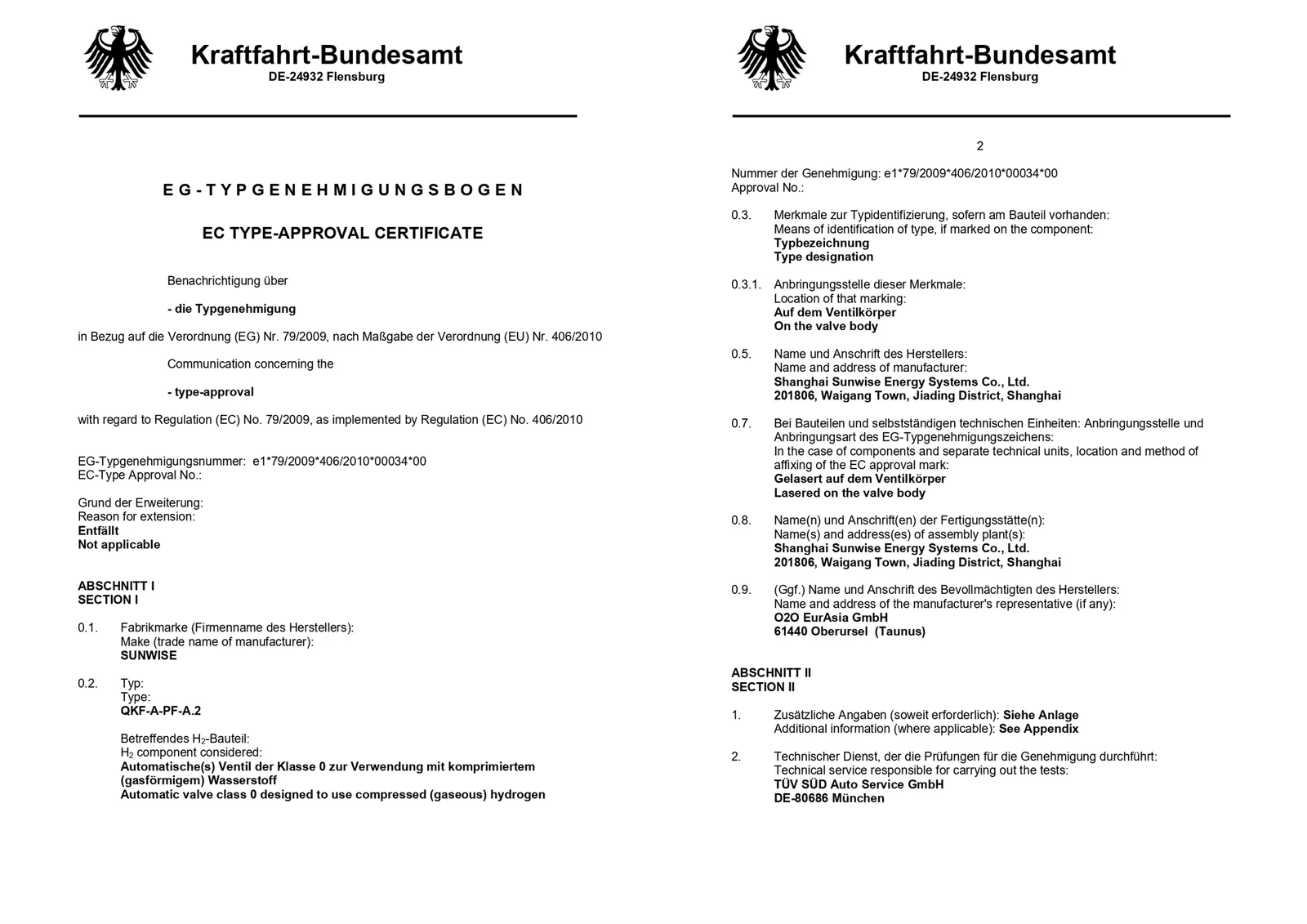
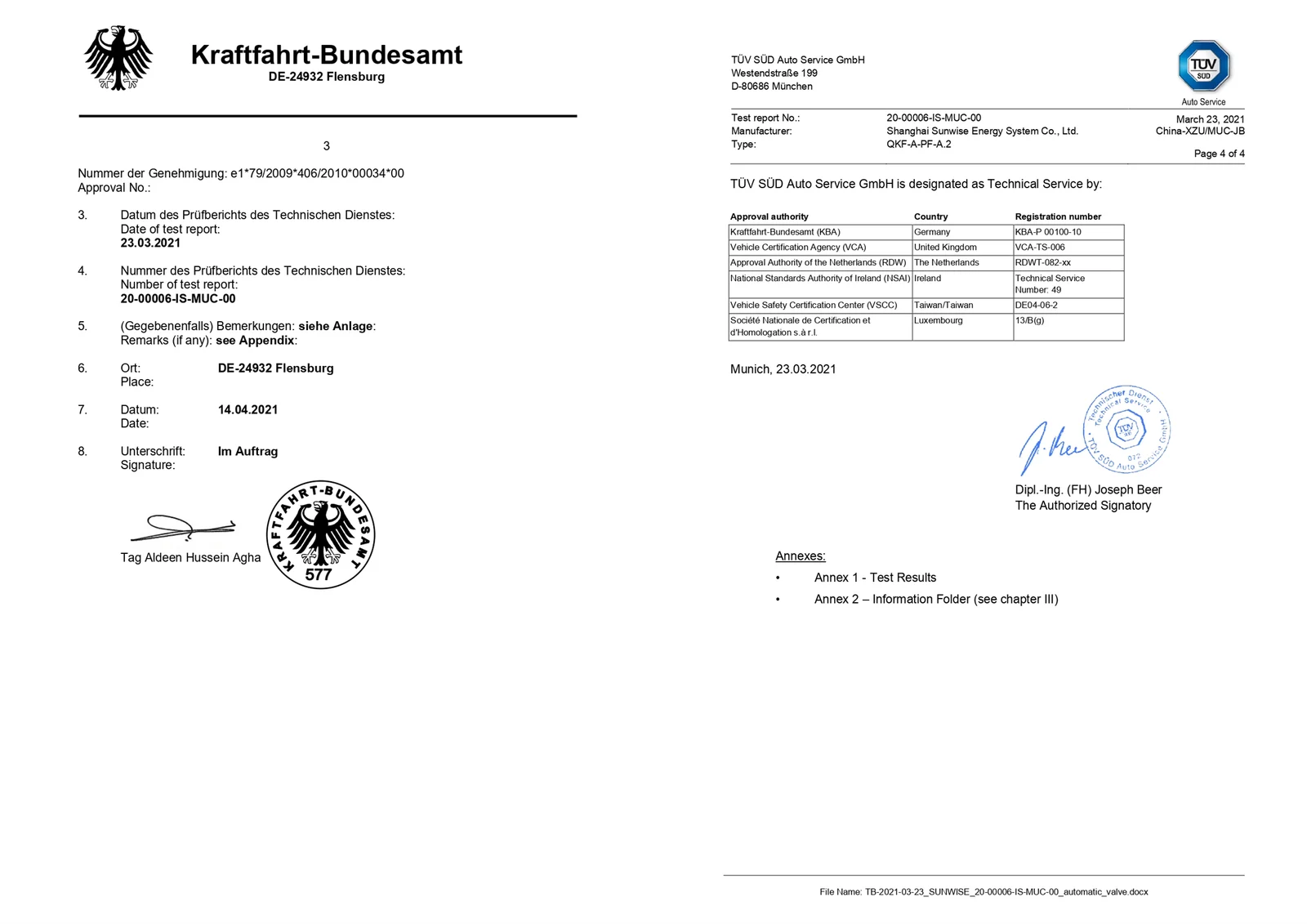
Certifying certificate
This certification is based on the European Standard EC79/2009 and EU406/2010, for the modules of the QKF-A vehicle, such as automatic valves, PRDs, manual valves, filters and sensors for combined hydrogen cylinder valves, and related components such as cylinder tail valves, emergency release valves, etc., have also been certified EC79/EU406.
The vehicle combined hydrogen cylinder valves are the key components of the vehicle-borne hydrogen storage system and, more importantly, the core parts of the fuel cell vehicle. Sunwise's autonomously developed combined hydrogen cylinder valves were first certified by the National Quality Review Authority's authorized unit, Dalian Cavator, and then certified by KBA in Germany, resolving not only a “crystal” problem, but also a sign that the key components of domestic fuel cell cars are internationally leading in the same products and have access to international markets.
Annex:
1 EC79
Regulation (EC) No 79/2009 of the European Parliament and of the Council of 14 January 2009 on the certification of hydrogen-powered vehicles and amending Directive 2007/46/EC, or EC 79 certification, is the EU regulation on the certification of the hydrogen-energy vehicle model, which establishes requirements for the certification and installation of motor vehicles and hydrogen-powered components and systems related to hydrogen propulsion.
2 EU406
EU406, the EU regulation on the implementation of the hydrogen energy vehicle model certification, sets out the regulatory requirements and related requirements for the implementation of the EC79 model certification, published by Commission Regulation (EU) No. 406/2010 of 26 April 2010 on the implementation of European Parliament and Council Regulation (EC) No. 79/2009 on the certification of the hydrogen energy motor vehicle model.
3 TUV
TUVNAND is the main sponsor of the International Alliance for Hydrogen Energy and the European Green Hydrogen Standards Certification Agency, which plays a pivotal role in the development of the world's hydrogen energy economy and industry. As a technical service agency authorized by the German Ministry of Transport (KBA), the certification and testing of the Green Hydrogen Certification and Hydrogen Fuel Cell Vehicle System and parts and components have been carried out in China, with corresponding standards EC79/EU406, ECE R134, GTR13 etc., to provide specialized services for the upgrading and export of the relevant products of domestic enterprises to the international market.
Editor: Zhang Master Poetry
This post is part of our special coverage Libya Protests 2011.
English edition of the original Chinese page. Historical statements, dates and figures are retained as published.