
Sunwise-built marine refueling station supports the maiden voyage of Three Gorges Hydrogen Boat No. 1
This archived announcement has been translated automatically from Chinese. Names and technical wording may require editorial verification. Original artwork is preserved where applicable.
The first hydrogen fuel cell power vessel in the country, the Tri-Gorge Hydro-One, recently sailed from the Eichan Tri-Gorge Visitors' Centre in the north of the lake to complete its first voyage in the Ei-Chang waters. This is a zero breakthrough in the application of domestic hydrogen fuel cell technology to inland water vessels and is a demonstration for accelerating the green low-carbon development of inland navigation. On the same day, the “Green Green Hydrogen Demonstration Station of the Three Gorges of China”, located at the Yi Changyang Bay pier, was officially shipped to provide energy supplies for the Three Gorge Hydrogen Ark 1.
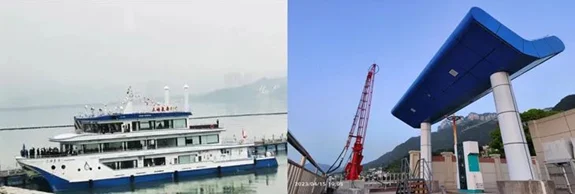
The demonstration station, which was partly built by Sunwise (Sunwise), used green power from three gorge power stations for electrolytic hydrogen, then compressed, stored and inflated the produced hydrogen gas to provide direct supply to hydrogen energy vessels, achieve self-sufficiency and improve hydrogen efficiency.
However, it's not that easy to hydrogen the ship. For example, gasoline is a liquid storage for ease of control, hydrogen is stored in the form of high-pressure gases and dangerous source control is more difficult; compared to hydrogen-energy vehicles, surface-based hydrogenation is mainly a hydrogen-filled gun, usually for a period not exceeding 10 minutes, but ship-filled hydrogen is highly inflated and of long duration, and therefore it is not appropriate to use land-based hydrogen-added guns for inflated equipment, and a more reliable means of infusion-connection should be used, taking into account the combined function of urgent cut-off between shores.
Because ships are in a mooring state, it is not possible to establish a fully fixed distance between the hydrogen-filler and the vessel's hydrogen mouth, generally at a level of 5 metres, whereas vertical distances are influenced by seasonal waterfalls and strong winds, with a deviation of 5 to 11 metres. This means that ships should be replenished with hydrogen with greater precision and speed, while ensuring safety. Through a variety of technical options, the Sunwise project group eventually adopted the hydrogenization method of “Folding Mechanical Arm Towed High Pressure Tube”, which is 240 kg of hydrogen per hour and meets 200 km for the continuation of the hydrogen fuel cell vessel.
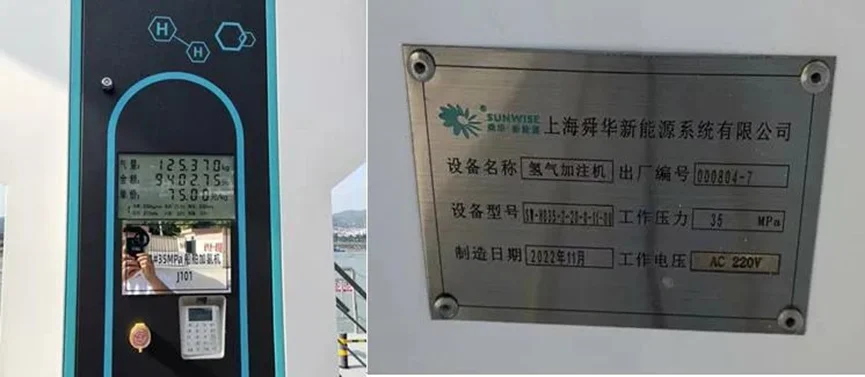
The Tri-Gorge Hydrogen Ark 1 was 49.9 metres long, 10.4 metres wide and 3.2 metres deep, with a passenger quota of 80 persons, mainly using the hydrogen fuel cell power system and a hydrogen fuel cell with a rated output power of 500 kW. Compared to traditional fuel-powered ships, it is expected that 103.16 tons of fuel will be replaced each year, reducing CO2 emissions by 343.67 tons.
English edition of the original Chinese page. Historical statements, dates and figures are retained as published.