
Pudong companies prepare for growth in the hydrogen industry
This archived announcement has been translated automatically from Chinese. Names and technical wording may require editorial verification. Original artwork is preserved where applicable.
Since the 2020 “double carbon” target, our hydrogen energy industry has been warming, and hydrogen production, which is dominated by green hydrogen, has become a great opportunity. The Long-term Plan for the Development of the Hydrogen Energy Industry (2021-2035), issued jointly by the National Development Reform Commission and the National Energy Authority in 2022, focuses on the development of renewable energy for hydrogen production and the strict control of fossil energy for hydrogen production. The green hydrogen is the hydrogen gas produced by renewable energy and the extraction process does not produce any carbon emissions. Among them, hydrolysis green hydrogen is an indispensable technology.
In the next 30 years or so, the production capacity of green hydrogen will grow hundreds of thousands of times — in 2021, our annual production of hydrogen was about 33 million tons, of which only 1 per cent was extracted through electrolysis, and the production of renewables was minimal; by 2060, under the “carbon neutral” vision, our annual demand for hydrogen is expected to increase to 130 million tons, 70 per cent of which is green hydrogen.
The wind has come, the men will fight for the deer. How do you do it?
In the eastern district of Zhangjiang Science City in Pudong, the Director-General of Shinyo (Shanghai) New Energy Technology Ltd. (hereinafter “Shanghai New Energy”) said that “Shanghai has not only many years of industrial experience but also strong scientific capacity in the fields of hydrogen fuel cells, electrolysis core materials and key technologies. He said that it would be useful to build core technical highlands of green hydrogen extraction equipment in Shanghai, targeting industry upstream.

The electrolysis cell is the core equipment for green hydrogen, and its demand is rising rapidly with industrial warming.
In an office building with a standardized industrial plant, a circular electrolysis cell of 500 was erected, with workers stretching the diaphragm 2 metres in diameter together with mats, bipolar panels and electrodes, and then placing it from up to down into the electrolytic cell. This operation will be carried out 200 times until 200 such combinations are installed in the cavity chamber of the electrolytic cell. Each “room” consisting of diaphragms, gaskets and bipolar plates constitutes the smallest functional unit of the electrolysis cell — the small room.
“In a small room like this, water is electrolyzed into hydrogen and oxygen. Goebbels says: H2+O2~H2O, a chemical reaction that we are all familiar with, will be reversible under electrical conditions, i.e. water is electrolyzed into hydrogen and oxygen, which is electrolytic hydrogen. If electrolysis is done with electricity provided by renewable sources of energy such as solar, wind, hydro, etc., this is hydrolysis green hydrogen.
The 30-ton electrolyte cell, which radiates new energy sources, is one of the most technologically mature and equipment-costed alkaline electrolytes. For large-scale industrial hydrogen, the alkaline electrolysis cell is the current major equipment. The global build-up of the alkaline cell was 727 MW in 2022, representing 52 per cent of the total load of the cell.
Our alkaline cell track is highly competitive, with nearly 200 producers. While green hydrogen is an inevitable trend, further technological efforts by enterprises are needed if it is to be replicated on a large scale.
“The alkaline cell industry is easy to enter and difficult to do. “The structure of this cell is simple and it can be combined into a cell by looking for drawings of several cells or by contacting the supplier of parts upstream of the cell to buy the materials back and fold them together. But the safety, reliability and energy consumption of these slots vary greatly. In fact, it is difficult to produce the same electrolytic cells with the same materials and the same processes without mature design experience and long process typologies. Photo by Flickr user pic.twitter.com
Industry points to the urgent need for rapid technological upgrades and changes in electrolytic hydrogen based on new applications and scenarios of new energy power. “There are many problems with the alkaline electrolytic hydrogen, including the decay of electrodes, plating, wear of diaphragms and the failure of seals. In addition, there has been a significant reduction in efficiency, and maintenance has been difficult to maintain and has to be brought back to the plant for maintenance, etc. "George Peak" means.
Foreign alkaline electrolysis cells are more advanced in diaphragms, electrodes and design than domestic products. For example, on the basis of the PPS diaphragm, the coating of other materials has become a composite new material with better resistance and lower face resistance; high-performance catalysts have been sprayed on electrodes, chemical activity has been upgraded and hydrogen production efficiency has been increased per unit; structural, based on complex hydrodynamics, can be designed to allow hydrogen to “produce and run fast” gas conduits...
When hydrogen energy becomes an indispensable part of our future energy structure, both core equipment and key materials, it is necessary to achieve a breakthrough from scratch. “This is why we have been insisting on technological innovation. "George Peak" means.
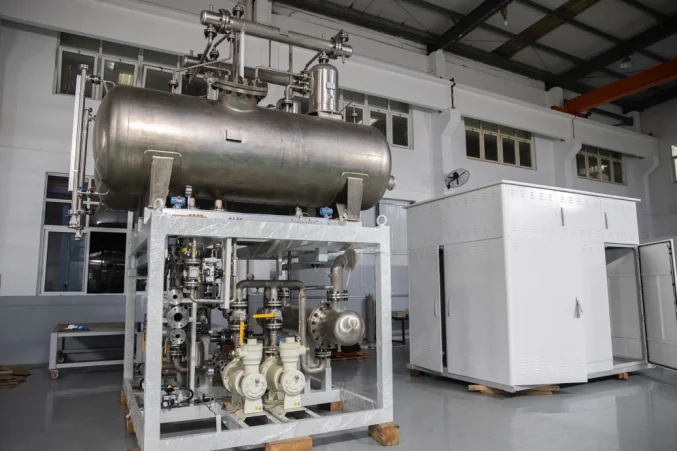
Large electrolytes are becoming the key to the success of the green hydrogen project.
In November 2022, alkaline electrolysis cell with a flow density of 3,000 a square metre was released to clear new energy sources, the industry average. In 2023, the company produced a new generation of products that increased current density to 6,000 anm2 by switching to an efficient catalyst electrodes, thus increasing the production of hydrogen in the 500-square cell by one-fold.
“For many years, R & D has settled and is developing paths that allow us to upgrade our products faster. “Emergency Peak revealed that the company plans to further enhance its product performance by introducing three generations of new diaphragm technologies this year.

The electrolysis cell will face the challenge of large-scaleization as domestic green hydrogen demonstration projects become available and as more large-scale green hydrogen projects emerge in the foreseeable future.
“In the light of the major energy trends, the large-scaleization of hydrogen-made equipment is a necessary trend. Tongji University's Deputy Director General of the New Energy Automobile Engineering Centre said, “Baltic electrolytic hydrogen is to be subjected to technical closures around the cost, efficiency, longevity, etc. of hydrogen-making equipment. Large-scale equipment can lead to lower efficiency gains, meaning that larger-scale green hydrogen production can be achieved under low energy consumption and high stability conditions. Photo by Flickr user pic.twitter.com
“In the light of the technological resource advantages of shareholders, we are building a 500-square-scale integrated hydrogen landscape demonstration system, based on municipal power, photovoltaic and electrochemical storage, which is an important initiative in the field of product validation and engineering applications. Together with the joint venture shareholders, we will develop a new model for integrated application of `windlight power plus hydrogen storage + hydrogen distribution', using the development of alkaline cell technology as an important development strategy for companies to enter the green hydrogen industry in the future. Photo by Flickr user pic.twitter.com
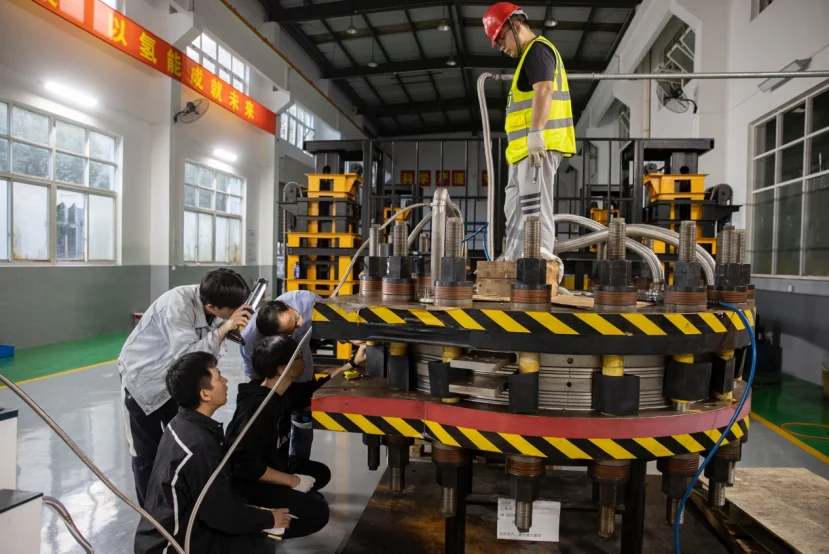
A growing number of hydrogen energy companies recognize that it is difficult to “package” a single type of electrolytic cell in the face of the diversity of the green hydrogen application landscape. For hydrogen-making equipment to be large, the same can be achieved by modular integration, not only through a zoom-in path.
While continuing to improve hydrogen production equipment, such as large-scale alkaline electrolytes, new sources of energy have been brought to light, and a number of commercial orders have been won by building up a model of solutions in the four main areas of transport, industry, storage and power generation. The future Green Power + Green Hydrogen is expected to be an important solution for deep decarbonization as the two-carbon goal moves forward.
“We have used Pudong and Shanghai as a base for enterprise research and development, integration testing and the creation of a central manufacturing base for core technology development and production of core parts and components. Depending on the regional distribution of the market, assembly centres are set up at the project conglomerates to provide a set of products and services close to the site. “We need Shanghai technology and innovation to win the green hydrogen market, both domestically and internationally. Photo by Flickr user pic.twitter.com
Reproduced from: Official Weibo by Pudong
English edition of the original Chinese page. Historical statements, dates and figures are retained as published.